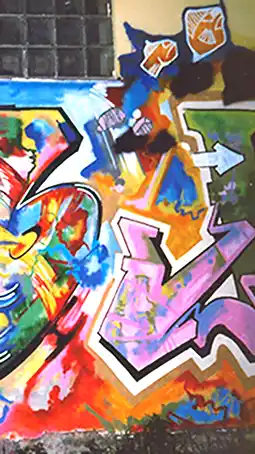
I början av året reste jag till Berlin. Jag kom att tänka på Daim. Undrar vad han gör just nu? Jag hörde av mig till honom och frågade: Hur är läget?
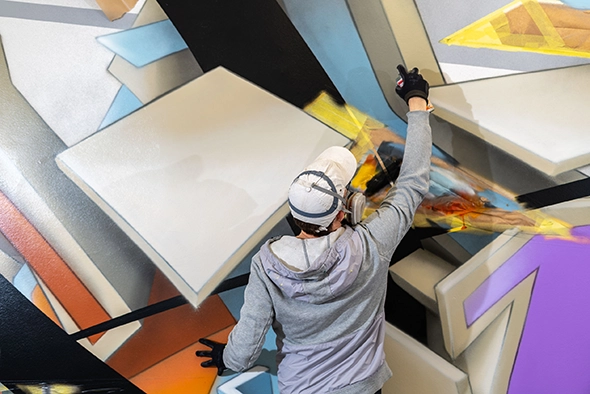
Interview with Mirko Reisser (DAIM)
Daim är Tyskland mest inflytelserika graffitikonstnär. Och därmed en av de världsledande när det kommer till graffitistil. Förutom pionjärerna från NY är det inte många som tillfört graffitiscenen så starka och betydelsefulla tillägg som Daim har gjort. Jag gjorde intervjun på engelska varför den presenteras så:
Current Life and Projects
How are you?
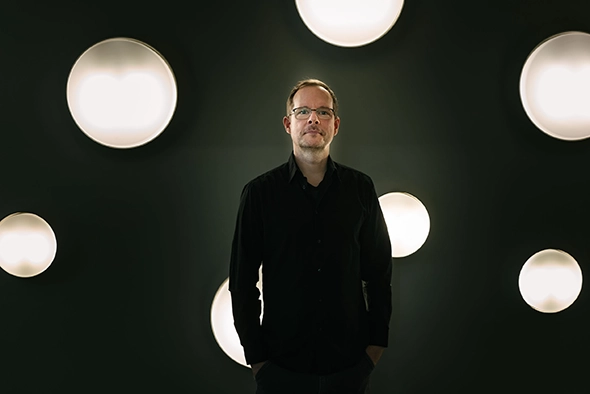
Thank you, I’m doing well. I’m at a point in my life where I can look back on more than three decades of working as an artist while still feeling curious about what comes next. That combination of experience and curiosity is something I value a lot. There are always new projects, new places, and new questions that keep me moving forward.
What is your life like right now?
My life is still very much centered around my work. That includes studio practice, exhibitions, large-scale murals, public art projects, and ongoing experimentation with materials and presentation formats. At the same time, I spend a lot of time reflecting on what I do and why I do it. As I’ve gotten older, understanding the process has become just as important as producing the work itself.
I’ve always seen my lettering as a kind of self-portrait. My development as a person and my development as an artist are closely connected. The work continues to evolve because I continue to evolve.
The Origins of 3D Graffiti
I have to start with the obvious question: Who started 3D graffiti? You or Pistol?
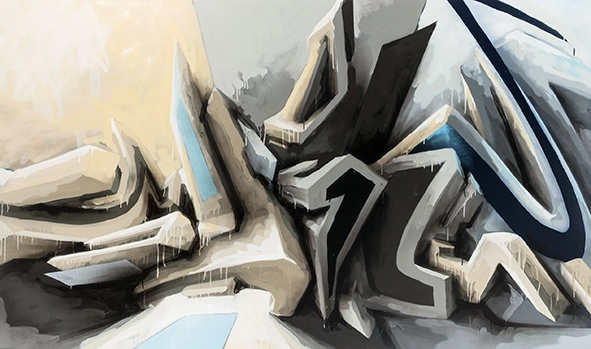
I don’t think it’s possible to reduce the development of 3D graffiti to a single person. Graffiti has always evolved through exchange, influence, competition, and experimentation. Many artists were exploring spatial effects, volume, and depth around the same time, often in different places and with different approaches.
What I can say is that in the early 1990s I became very focused on creating letters without traditional outlines and instead building them through light, shadow, and form. That approach became strongly associated with my work and helped establish what many people today identify as a 3D style. But like most artistic developments, it was part of a broader conversation rather than a single invention.
Three-Dimensional Form and Artistic vision
How is it that you have the ability to not only think three-dimensionally but also express it so strongly?
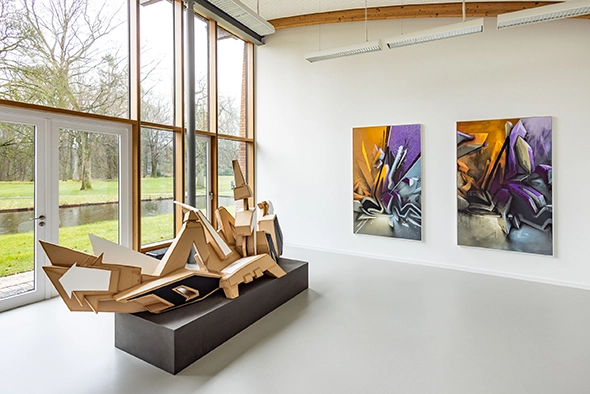
I don’t think of it as a special ability. For me it was a logical consequence in the evolvement of my work. I spent years drawing realistically and was fascinated by artists such as Van Gogh and Dalí. What interested me was how form could emerge through light and shadow rather than through outlines.
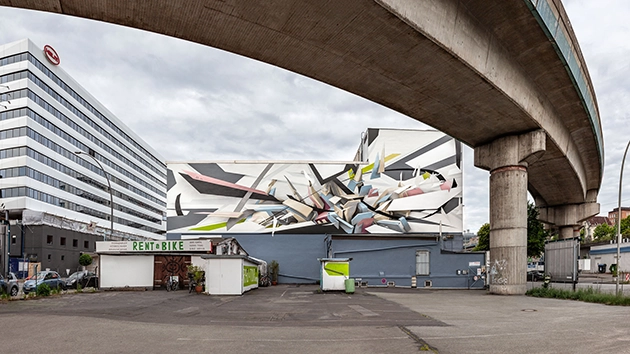
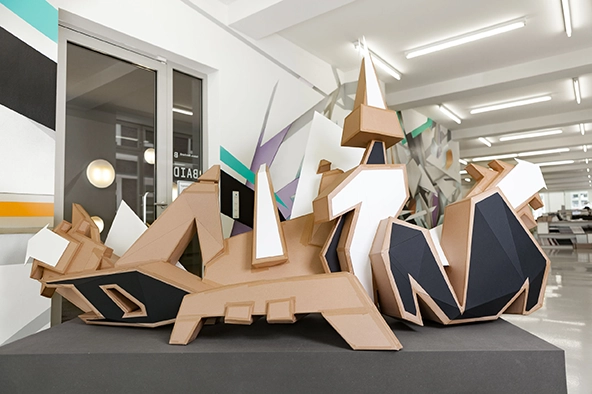
When I started painting graffiti, I simply transferred that way of thinking into lettering. Instead of defining letters with a black contour, I wanted them to exist as objects in space. Over time that became more complex. Today the work is not only about creating three-dimensional letters but about constructing and deconstructing typography, pushing forms into space while simultaneously questioning them.
Education and Influences
How has your own development been educationally? Who was your role model? Are you self-taught or schooled? How do you develop your sketches and templates?
I would describe myself as both self-taught and formally educated.
Before studying art, I had already spent many years drawing and painting. Graffiti itself taught me an enormous amount through practice, observation, and exchange with other writers. In 1996, after several years in the graffiti scene, I decided to broaden my perspective and studied Fine Arts at the Lucerne University of Applied Sciences and Arts in Switzerland. That experience was extremely important because it pushed me to think beyond the wall and engage with sculpture, installation, presentation, and context.
As for influences, my first graffiti book was actually Graffiti Live – Die Züge gehören uns. Because of that, my early influences came less from New York and more from European and especially German writers. Artists such as Loomit, Skena and Cemnoz made a strong impression on me at the time.
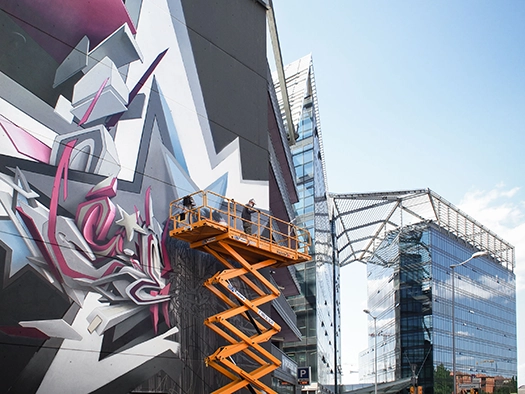
My process today usually begins with studying the location very carefully. After considering the architecture, scale, and context, I create pencil sketches. These sketches are then developed digitally using vector-based software, allowing me to refine structures and compositions before executing the final work.
The German Graffiti Scene Today
What is generally happening in the German graffiti scene today, in 2026, and what do you see coming in the next few years?
The German graffiti scene has become incredibly diverse. Today there are artists working purely within traditional writing culture, others moving into galleries and museums, and many who operate somewhere between those worlds.
What interests me most is that graffiti has matured without losing its energy. Younger artists have access to tools, information, and international networks that simply didn’t exist when I started. At the same time, the challenge remains the same: developing an authentic visual language rather than following trends.
I think the coming years will bring even more crossovers between graffiti, architecture, digital technologies, installation, and public space. But despite all these developments, lettering will always remain at the core of graffiti culture and the alphabet still offers an almost endless field for experimentation.
Scandinavia and Career Highlights
Have you been up with us in Sweden and painted?
Unfortunately, I have never painted in Sweden. I have, however, worked in other parts of Scandinavia over the years. I have painted and exhibited in Denmark and have also had the opportunity to work in Finland.
Scandinavia has always been interesting to me because there is a strong appreciation for public art, architecture and design. I would definitely like to show my work in Sweden one day.
Would you be kind enough to share with us your 3 strongest memories of your painting over the years?
There are many, but three moments immediately come to mind:
1. Painting my first graffiti in 1989
The first piece changed everything for me. It was painted with two friends in broad daylight in Hamburg. From that day on I knew that I never wanted to do anything else than paint. It felt like finding something I had been searching for without knowing it.
2. Discovering New York and becoming part of an international graffiti network
Travelling and painting internationally expanded my understanding of graffiti enormously. New York in particular represented a direct connection to the roots of the culture. Meeting writers from different countries showed me that graffiti was a truly global language.
3. Realizing the “World’s Tallest Mural” in Calgary
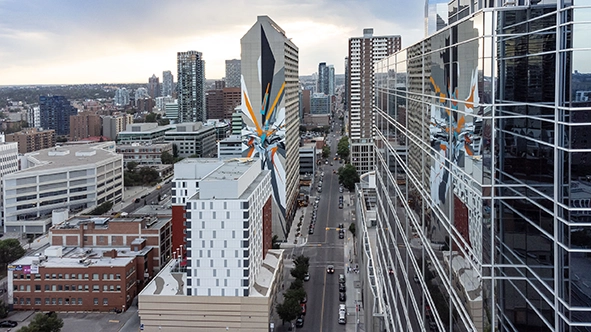
Another very strong memory is the “World’s Tallest Mural” in Calgary, which I realized in 2022 as part of the BUMP Festival. At 96 meters, the scale of the work changed everything. What fascinated me most was how differently the piece could be perceived: from street level, from the surrounding high-rises, and even from the air when approaching Calgary.
For me it was a very special moment to realize my DAIM lettering in such a dimension, right next to the iconic Calgary Tower, and to become part of a project that placed Calgary on the international map as a city for powerful public art.
Architecture and Spatial Thinking
Have you ever been involved in a physical new production of rooms, houses or properties based on your painting? That is, a house built in your style.
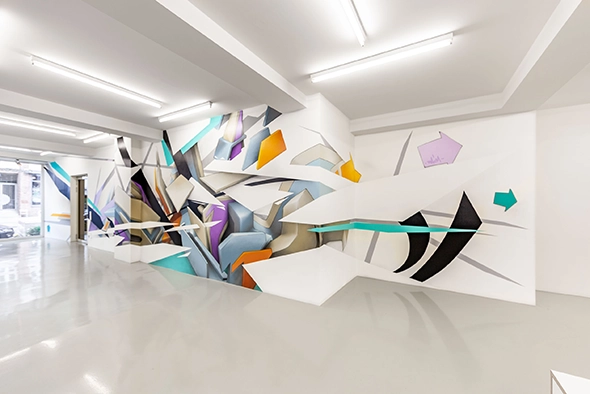
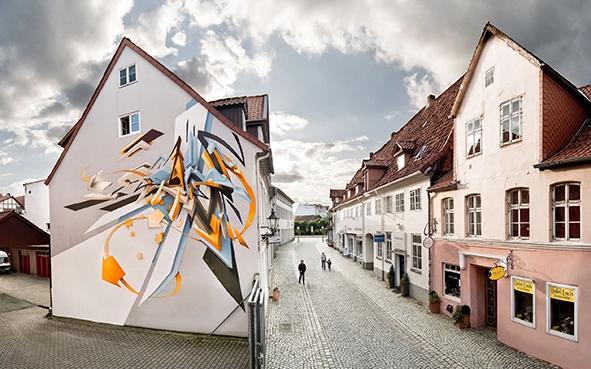
Not in the sense of an entire house being constructed according to my visual language. However, I have worked extensively in the fields of architecture, public space, and art-in-architecture. Over the years I have realized large-scale projects integrated into buildings, infrastructure, and urban environments.
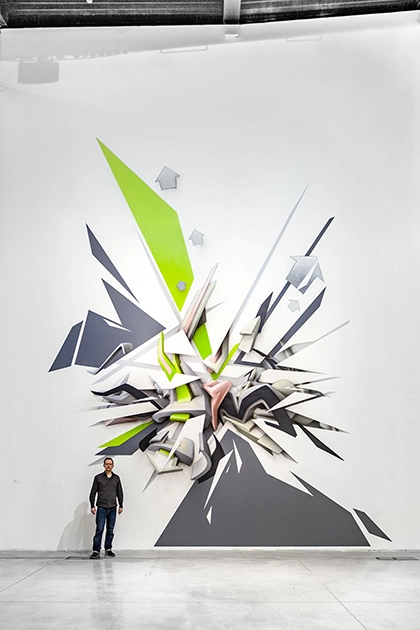
My work has always had a strong architectural component. Many people have described it as a kind of ”typographic architecture” because the letters are constructed almost like buildings. So while I have not designed an entire house in my style, architecture and spatial thinking have always been deeply connected to my practice.
Mirko Reisser (DAIM) – Urban Contemporary Art
officiell merch